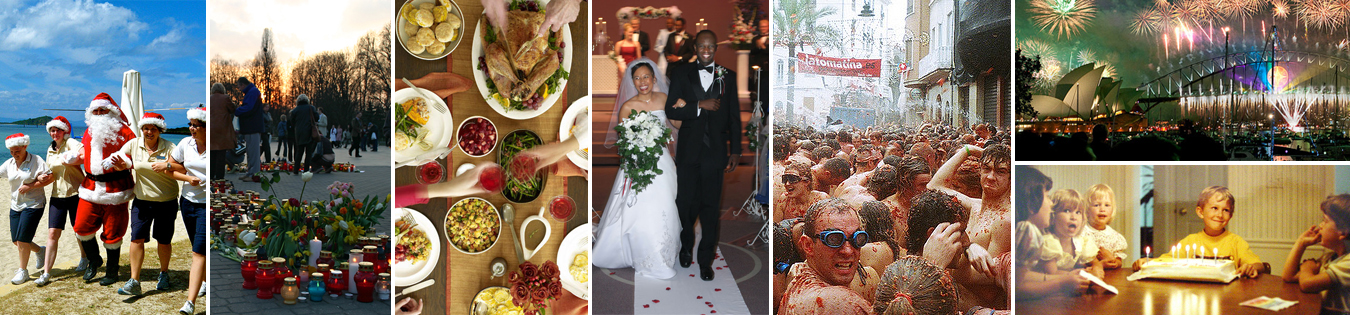
Work in small groups. Look at the photos. Where are these families? What holiday/festival is it? Use some of these phrases:
(They) may/might/could be. . . (This) seems to be. . .
(They are) probably. . . (This is) certainly. . . because. . .
Below is the UK {bank holiday;bank holiday = public holiday on which all banks and many other businesses are closed.} calander. Do you know all of them? If not, hover your mouse over the holidays on the right to find out what they are and what people do on those days.
| Bank holidays in the United Kingdom |
|
| 1 January | {New Year;New Year's celebrations to welcome the start of the new year on New Year's Eve, the 31st of December. People celebrate at home, in pubs, clubs, or in the street. They sing or dance and count down the seconds to the new year. At midnight they drink a toast and light fireworks. On New Year's Day most people stay at home and relax.} |
| Friday before Easter | {Good Friday;Good Friday commemorates the suffering of Jesus Christ and his death on the cross. Many people fast on that day.} |
| Monday in March or April | {Easter Monday;Easter Monday is the bank holiday that follows Easter Sunday. It is another day of Easter festivities that celebrates the resurrection of Jesus.} |
| first Monday of May | {Early May bank holiday;Early May bank holiday is celebrated on the first Monday in May. On that day people celebrate the coming of spring and the beginning of warm days. A popular tradition associated with that day is maypole dancing. Children, particularly young girls, dance around a tall pole, decorated with colourful ribbons.} |
| last Monday of May | {Spring bank holiday;Spring bank holiday is celebrated on the last Monday in May. It is a day off for relaxation, work around the house, or trips in the country.} |
| last Monday of August | {Summer bank holiday;In England on the last Monday in August, people celebrate the end of summer. They have a day off for relaxation, work around the house or trips. At that time there is a popular Notting Hill Carnival in London.} |
| 25 December | {Christmas;Christmas celebrates the birth of Jesus Christ. On Christmas Eve, the evening before Christmas, people decorate homes and streets with pine trees, lights, and other decorations. Children put up stockings to receive gifts from Santa Claus, also called Father Christmas. On Christmas day, family members exchange gifts and have a special meal that traditionally includes turkey, potatoes, and Christmas pudding.} |
| 26 December | {Boxing Day;Boxing Day is the day following Christmas. Traditionally servants and employees would receive Christmas boxes containing gifts from their bosses and employers. Today it has become a day of big sales and shopping.} |
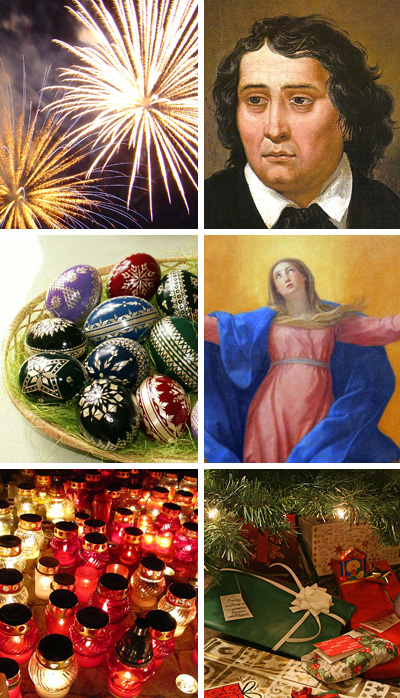
Christmas, Reformation Day, Day of Uprising Against Occupation, Statehood Day, Prešeren Day, May Day Holiday, New Year's Day, Easter Monday, Assumption Day, Day of the Dead, Independence and Unity Day
| 1 January:
New_Year
8 February: Prešeren_Day March/April Monday: Easter_Monday 27 April: Day_of_Uprising_Against_Occupation 1 and 2 May: May_Day_Holiday 25 June: Statehood_Day 15 August: Assumption_Day 31 October: Reformation_Day 1 November: Day_of_the_Dead 25 December: Christmas 26 December: Independence_and_Unity_Day |
|
Work in pairs. Imagine that your partner is a foreigner. Explain to him/her what each Slovenian holiday means and how it is celebrated. Switch roles.